Maap AI, built around the product MAAP (Malnutrition Assessment and Action Plan), is a healthcare technology company focused on one specific operational gap: accurately measuring child growth in low-resource settings.
In many parts of India and similar markets, tracking height and growth requires equipment, trained personnel, and time. In practice, this leads to large numbers of children being either not measured regularly or measured inaccurately.
Maap AI was created to simplify this process using a device that is already widely available: a smartphone.
Origin
The company emerged from grassroots work in public health and nutrition. Its founding team includes Romita Ghosh, who has a background in biotechnology and digital health, and Nilashis Roy, who specialises in AI and computer vision systems. Their combined experience reflects the direction of the company—using technical tools to solve very specific public health problems.
Product
The core insight behind Maap AI is straightforward. Child growth, especially height-for-age, is one of the most important indicators of malnutrition. But measuring height typically requires stadiometers or physical tools, which are not always available in rural or field settings. Even when available, measurements can be inconsistent due to human error.
Maap AI replaces this with a camera-based system.
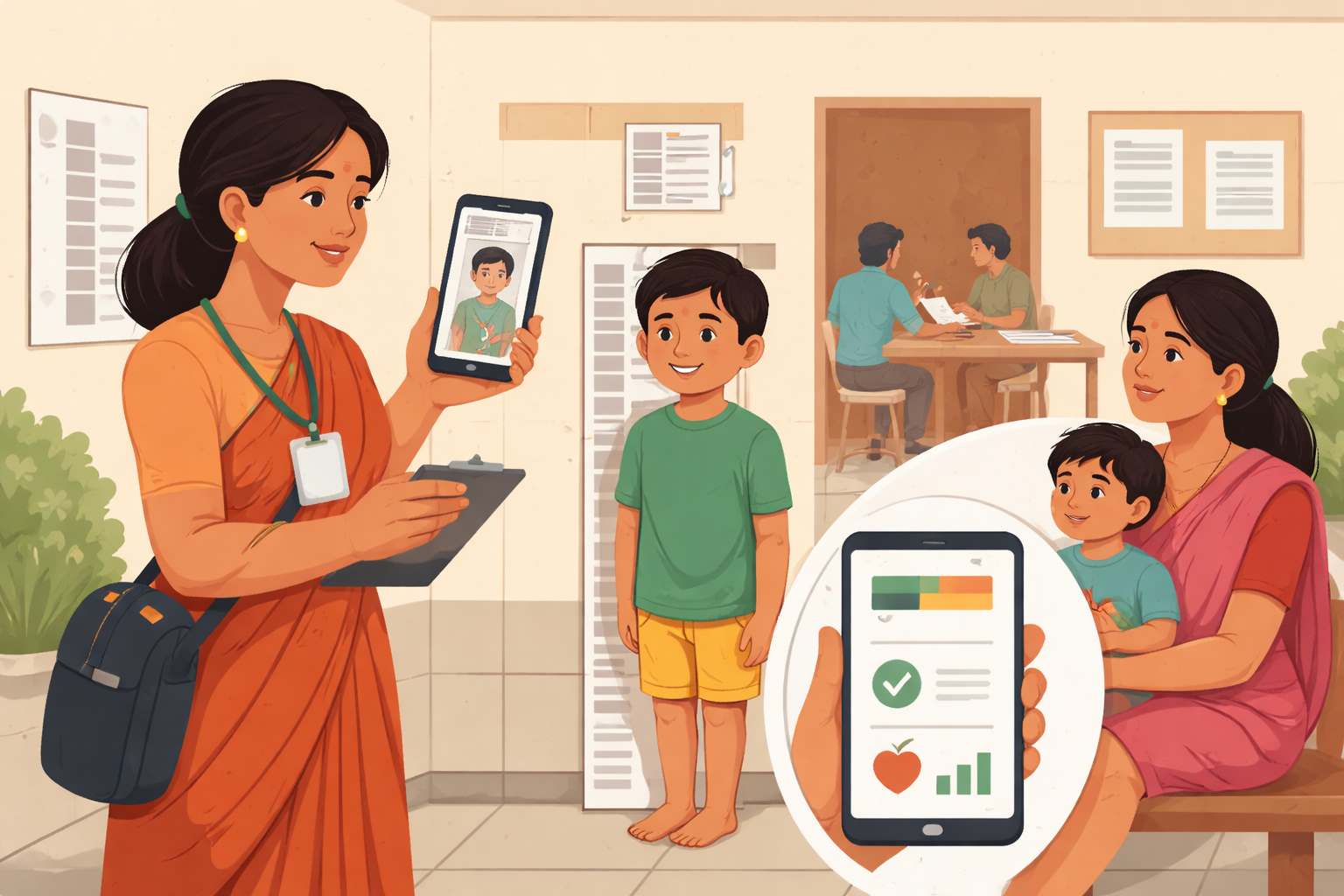
At the centre of its product is a smartphone application that uses computer vision to estimate a child’s height from a single photograph. The process is designed to be simple enough for frontline workers, caregivers, or even parents to use.
The system works in a few steps. A user takes a photo of a child using the app. The AI model analyses the image, identifies key reference points such as body proportions, and calculates an estimated height. This is done using trained algorithms that have learned from large datasets of annotated images.
Once height is estimated, the system compares it against standard growth benchmarks, such as WHO growth charts. This allows the app to determine whether the child is within a healthy range or showing signs of stunting or undernutrition.
But the system does not stop at measurement. It connects growth data with nutrition insights. Based on the child’s condition, the platform generates an action plan. This can include dietary suggestions, alerts for further medical attention, or recommendations for follow-up monitoring.
In practice, the output is kept simple. Instead of presenting raw charts, the app translates results into clear guidance that a field worker or caregiver can act on immediately.
This combination of measurement and action is what defines the product.
Maap AI is designed to work within existing public health systems. It aligns with government programs such as Poshan 2.0 and integrates with tools like the Poshan Tracker, which is used by frontline workers in India. This allows the data collected through the app to feed into broader monitoring systems.
The primary users of the system are Anganwadi workers, healthcare workers, NGOs, and government agencies. In many deployments, a field worker uses the app during routine visits, capturing growth data and updating records in real time.
One of the practical advantages of this approach is speed. Traditional measurement can take several minutes per child and may require multiple attempts. The Maap AI system reduces this to a quick photo capture, making it feasible to screen larger populations more frequently.
Another advantage is consistency. Since the measurement is algorithm-driven, it reduces variation caused by different individuals taking measurements in slightly different ways.
Deployment
The company has been deployed in pilot programs with healthcare organisations and development agencies. These deployments focus on improving early detection of malnutrition, particularly in underserved regions. Early results indicate that smartphone-based measurement can significantly increase screening coverage and frequency.
This matters because malnutrition is often underdiagnosed. Millions of children remain unmeasured or are identified too late for effective intervention. By lowering the barrier to measurement, Maap AI shifts detection earlier in the lifecycle.
Challenges
However, challenges remain. Camera-based measurement depends on image quality, lighting conditions, and positioning. Ensuring consistent accuracy across diverse field conditions requires continuous model improvement. There is also the need to train users on how to capture images correctly.
Maap AI operates in a niche but growing category: digital tools for anthropometry and nutrition monitoring. Traditionally, this space has relied on physical tools and manual data entry. Over time, digital health platforms have started to digitise records, but measurement itself has remained largely unchanged.
Maap AI shifts the measurement step into the digital layer.
Global context
Globally, there are a few efforts in similar directions. Some startups and research groups are exploring camera-based or sensor-based methods for health measurements. However, many of these are still in experimental stages or focused on clinical environments.
What distinguishes Maap AI is its focus on field deployment in low-resource settings. The system is built to work with minimal infrastructure, which is critical in large-scale public health programs.
The broader category sits within digital public health infrastructure. Governments and organisations are increasingly investing in systems that can monitor population health in real time. This includes tools for tracking nutrition, disease, and maternal health.
In this context, measurement becomes a foundational layer. Without reliable data, interventions cannot be targeted effectively. Maap AI addresses this by turning a previously manual process into a scalable, digital one.
India presents a particularly relevant use case. The country has one of the largest child populations in the world and continues to face challenges related to malnutrition. Programs exist at scale, but their effectiveness depends heavily on accurate, timely data from the ground.
Maap AI’s approach fits into this ecosystem by strengthening the data layer rather than replacing existing programs.
As the company evolves, its trajectory will likely depend on three factors. The first is accuracy—ensuring that camera-based measurements remain reliable across geographies and conditions. The second is integration—embedding the system deeply into government and institutional workflows. The third is scale—expanding deployments to cover larger populations.
The long-term direction of this category points toward continuous, real-time health monitoring using accessible devices. Smartphones, combined with AI, are becoming tools not just for communication but for measurement and diagnostics.
Maap AI is building within this shift, focusing on one specific metric—child growth—but addressing a large operational problem behind it.
- Our Correspondent