Makers Hive was founded in 2018 in Hyderabad with a clear focus on building practical and affordable medical devices. The company was started by Pranav Vempati along with Harsha Reddy Ponguleti and Suren Marumamula.
The founding insight came from a simple but persistent problem. Advanced prosthetic hands available globally were too expensive for most users in India. At the same time, many amputees relied on basic mechanical prosthetics that offered limited functionality. The founders set out to build a device that could deliver useful functionality at a fraction of the cost, using locally available manufacturing methods and simpler engineering approaches.
What is KalArm
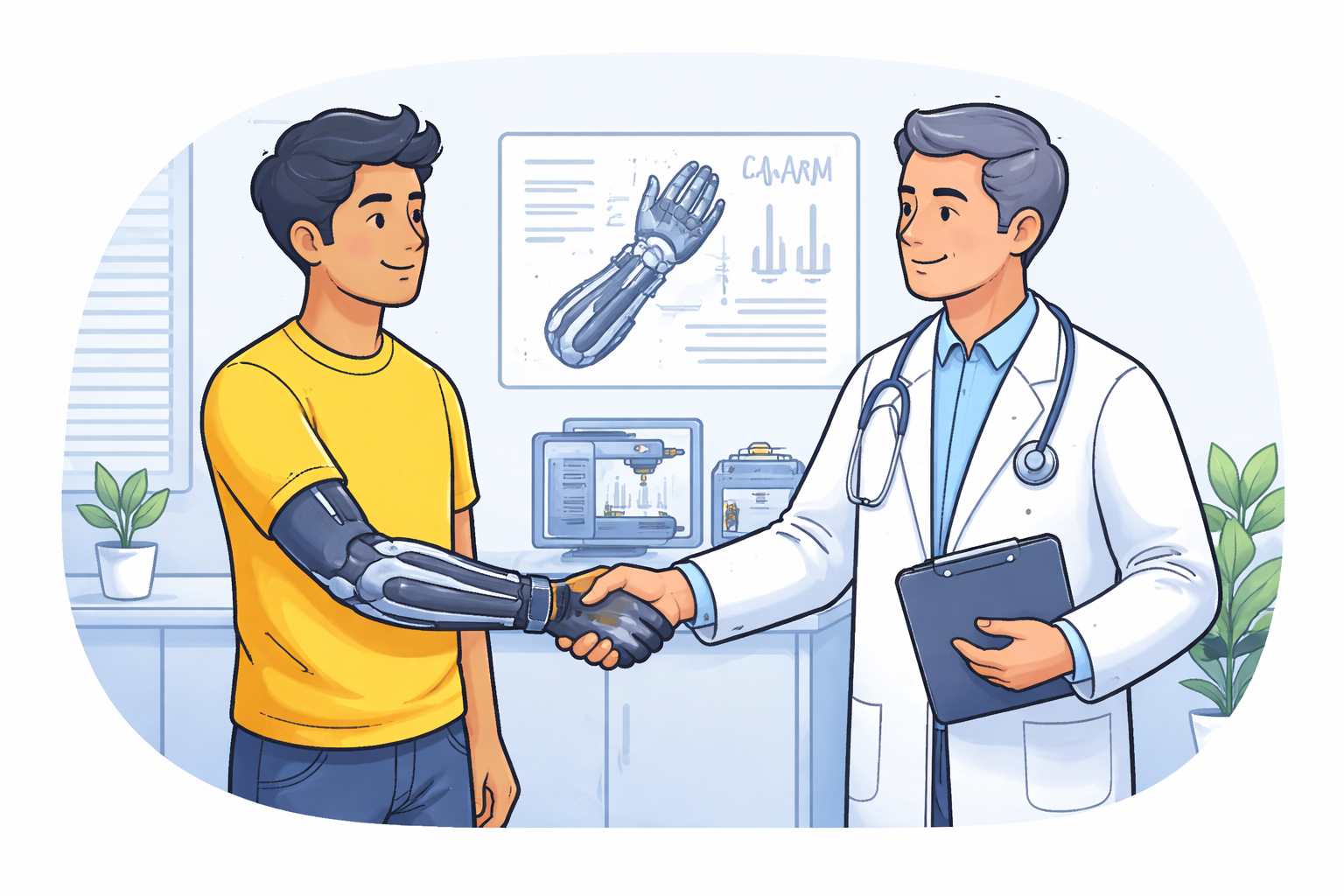
KalArm is a myoelectric bionic hand designed for people with upper limb amputations. Unlike mechanical prosthetics that rely on body movement or cables, KalArm is controlled using electrical signals generated by muscles.
When a user attempts to move their missing hand, the muscles in the residual limb still produce electrical signals. KalArm captures these signals through sensors placed on the skin and converts them into movements of the prosthetic hand. This allows users to perform tasks such as gripping objects, holding tools, or eating independently.
How the System Works
The system is built around three main layers: sensing, processing, and actuation.
The sensing layer uses EMG sensors to detect muscle activity. These sensors pick up very small electrical signals generated when muscles contract. Different movements produce different signal patterns.
The processing layer interprets these signals. The device maps patterns to specific actions such as opening or closing the hand or switching between grip types. KalArm supports multiple grip modes, allowing users to adapt the hand for different tasks.
The actuation layer consists of motors and mechanical linkages inside the prosthetic. These components move the fingers based on commands from the controller. The design focuses on reliability and ease of maintenance rather than extreme precision.
The system also connects to a mobile interface, where users or clinicians can adjust settings, calibrate signals, and update software. This adds flexibility, especially during the initial training phase.
Design and Customisation
KalArm is designed to be customized for each user. The socket, which fits onto the residual limb, is tailored to ensure comfort and proper signal detection. The size and structure of the hand can also be adjusted.
3D printing plays a key role here. It allows rapid prototyping and customization without significantly increasing cost. This is important because prosthetics need to fit well for long-term use. Poor fit often leads to discomfort and eventual abandonment of the device.
The overall design aims to balance weight, durability, and usability. The device is lightweight enough for daily wear but sturdy enough for routine activities.
Cost and Accessibility
One of the defining aspects of KalArm is its pricing. The device typically costs between ₹4.5 lakh and ₹6 lakh. This is significantly lower than imported bionic hands, which can cost several times more.
This cost reduction comes from a combination of local manufacturing, simplified design, and selective use of components. Instead of aiming for maximum technological complexity, the company focuses on delivering the most useful features in a cost-effective way.
Makers Hive has also worked with hospitals, NGOs, and CSR programs to make the device accessible to users who cannot afford it outright.
Deployment and Real-World Use
KalArm is deployed through prosthetics and orthotics clinics across India. These clinics handle fitting, calibration, and training. Users typically go through a learning period where they understand how to control the device using muscle signals.
The device has been used across different segments, including individuals with below-elbow and above-elbow amputations. It is also being tested and deployed in sectors such as rehabilitation and assistive care.
Manufacturing is supported by facilities like the Andhra Pradesh MedTech Zone, which provides infrastructure for regulated production.
User Experience
KalArm is designed for everyday functionality rather than specialized tasks. It supports multiple grip patterns and can handle common activities such as holding utensils, carrying objects, and operating simple tools.
User feedback often highlights practical improvements in daily life. Tasks that were previously difficult or required assistance become manageable. This includes eating independently, holding personal items, or performing basic household activities.
There are still limitations. The device does not match the precision or responsiveness of the most advanced global prosthetics. However, it focuses on reliability and usability, which are often more important in daily use.
Funding
Makers Hive has raised over ₹30 crore in funding so far. The company has taken a steady approach to growth, focusing on product development and clinical deployment rather than rapid expansion.
It is currently working on newer versions such as KalArm Lite and KalArm X, which aim to improve usability and reduce cost further. The company is also preparing for international regulatory approvals to expand beyond India.
Competition
KalArm operates in the broader category of myoelectric prosthetics. Globally, companies like Ottobock and Open Bionics build advanced prosthetic hands with high precision and advanced control systems.
These devices often offer more features but come at significantly higher costs. On the other end, there are low-cost prosthetics that are more affordable but lack functionality and durability.
Makers Hive positions itself between these extremes, offering a device that balances cost and functionality while being suitable for clinical use.
Global context
The global prosthetics industry has been moving toward smarter, sensor-driven devices. Traditional prosthetics were mostly mechanical, relying on simple movements. Modern systems use sensors, processors, and software to enable more natural interaction.
However, accessibility remains a major issue. Most advanced devices are designed for high-income markets, leaving a large gap in affordability.
Companies like Makers Hive represent a shift toward localized innovation. They adapt technology to fit local cost structures, manufacturing capabilities, and user needs. This often involves simplifying designs, using alternative materials, and integrating digital tools in practical ways.
How is KalArm different
KalArm stands out because of how it prioritizes usability over complexity. It does not attempt to replicate every feature of high-end prosthetics. Instead, it focuses on the set of functions that matter most for everyday life and ensures those work reliably.
The combination of 3D printing, modular design, and local manufacturing allows faster iteration and customization. The addition of software through mobile interfaces adds flexibility without significantly increasing cost.
- Our correspondent