The story of Eye-D begins not in a lab, but in a moment of observation. Around 2012, Gaurav Mittal attended an event at the National Association for the Blind.
What struck him was not the limitation of technology, but the gap between capability and everyday life. Skilled programmers who could handle complex systems still relied on a simple white cane to navigate the world. That contrast became the seed of an idea: what if technology could quietly sit in the background and act as a constant companion?
That idea evolved into Eye-D, formally founded around 2014–15 by Gaurav Mittal along with Vaibhav Asthana and Subodh Mittal. The company emerged from a parent entity, GingerMind Technologies, after a period of experimentation that included multiple hardware prototypes.
Those early years were not about scale, but about understanding—how visually impaired users interact with their surroundings, what slows them down, and what kind of assistance feels natural rather than intrusive.
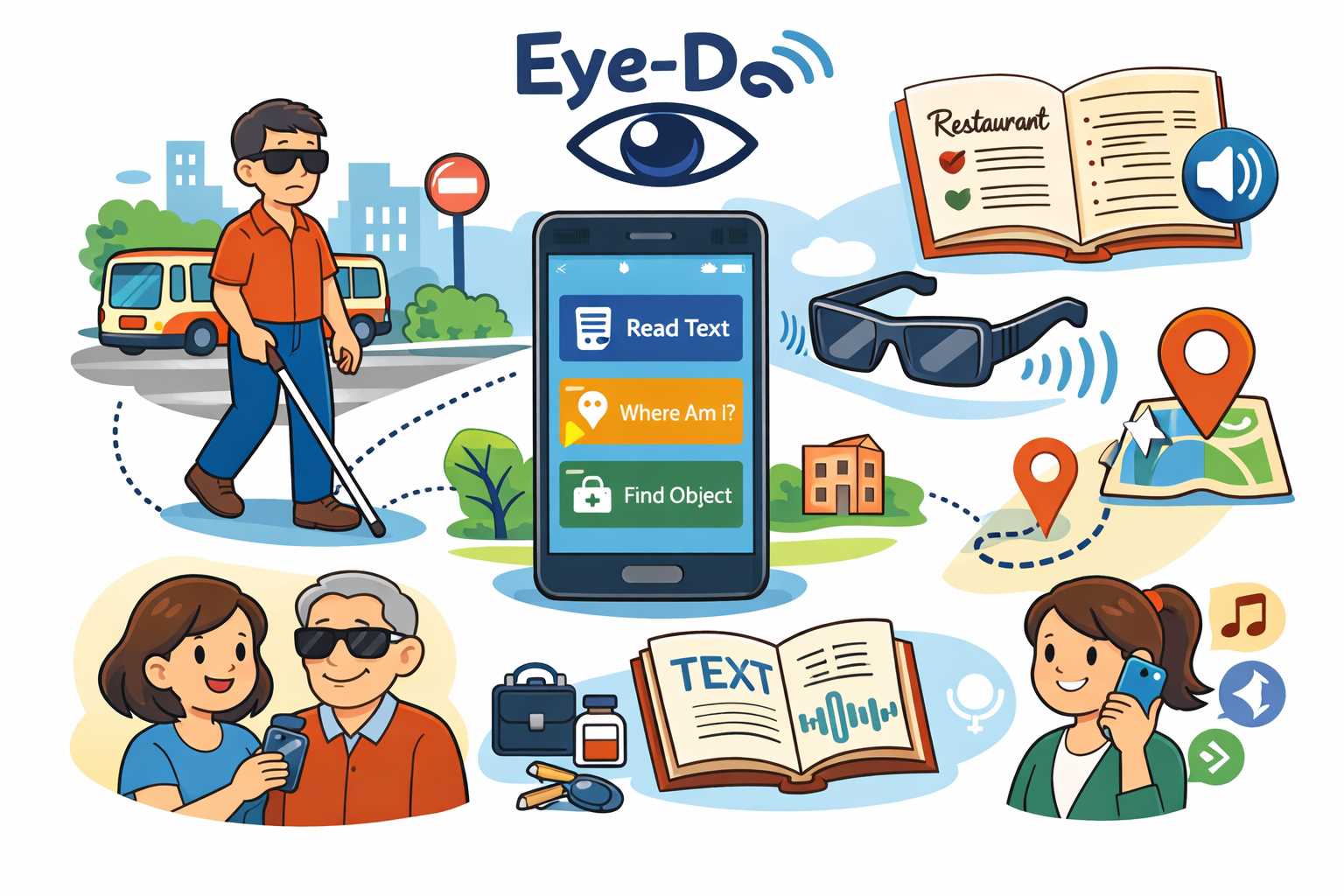
By 2016, this thinking translated into a tangible product: the Eye-D Pro app. It was designed as a simple smartphone application that could read text, identify objects, and help users navigate their environment using audio feedback.
The choice of a smartphone as the primary interface was deliberate. Instead of building expensive standalone hardware, the team chose to build on a device many users already owned. This decision would later define the company’s approach.
The product itself is best understood not as a single feature, but as a bundle of small, practical tools. A user can point their phone at a restaurant menu and have it read aloud. They can use a “Where am I” feature to understand their location and nearby landmarks. They can identify objects in front of them or navigate to a destination with voice guidance.
In many ways, the app behaves like a “Swiss Army knife” for daily tasks—simple actions that sighted individuals take for granted, but which often require assistance for someone with visual impairment.
What makes Eye-D interesting is not just what it does, but how it does it. A large part of its functionality is powered by artificial intelligence, particularly in areas like object recognition and text reading. But the technology is intentionally kept invisible. The user experience is designed to be straightforward: point, click, listen. This matters because complexity, even if technically impressive, can become a barrier in assistive tools.
Over time, the company expanded beyond software. One of its experimental products, the Eye-D Cam, is a wearable device—essentially smart glasses—that provides audio feedback about the environment. This project has been piloted internationally, including collaborations such as one with the Barcelona City Council. The wearable approach reflects a broader ambition: moving from handheld assistance to more seamless, real-time support.
Funding for Eye-D has followed a path typical of early-stage social impact startups. In its early days, the team relied heavily on personal savings and struggled to attract investors.
Over time, support came through grants and institutional backing, including funding from organizations such as Microsoft, Intel, and Citrix, as well as support from the Karnataka government. The company has largely remained in the grant and early funding stage, reflecting both the niche nature of the market and the challenges of monetising assistive technologies.
Despite these constraints, adoption has been steady and global. Eye-D reports usage across more than 160 countries, with tens of thousands of users.
In India alone, the app has reached users in hundreds of cities. What is notable here is not just the scale, but the diversity of contexts in which the product is used—from urban navigation to everyday reading tasks.
User feedback has played a central role in shaping the product. Early on, one of the biggest challenges was simply getting visually impaired users to try the app.
Trust had to be built gradually, often through community organizations and direct engagement. Once adopted, however, the response has tended to focus on independence. Users frequently highlight small but meaningful changes: not needing to ask for help to read a menu, being able to navigate unfamiliar places, or identifying objects without assistance.
In the broader landscape, Eye-D sits within a growing category of assistive technologies aimed at visual impairment. Globally, this space includes everything from screen readers and OCR-based apps to more advanced wearables and even experimental systems using eye-tracking or augmented reality.
Companies and initiatives like Oswald Labs have focused on making digital content more accessible, while others have explored hardware-heavy solutions such as smart glasses.
What distinguishes Eye-D is its emphasis on accessibility over sophistication. Many global solutions rely on specialised hardware, which can be expensive and difficult to distribute, especially in emerging markets. Eye-D’s smartphone-first approach lowers the barrier to entry significantly. It aligns with a broader trend in assistive technology: moving from specialised devices to software that runs on everyday consumer hardware.
This approach also reflects a shift in how assistive technology is being designed. Earlier generations of solutions often treated disability as a problem to be solved with dedicated tools. Newer approaches, including Eye-D, treat it as a context in which mainstream technology can be adapted.
At the same time, the company’s journey highlights some of the structural challenges in this sector. Funding remains limited, especially compared to mainstream consumer technology. User acquisition requires deep engagement with communities rather than traditional marketing. And scaling globally involves navigating different languages, accessibility standards, and infrastructure constraints.
Yet, Eye-D’s progress suggests that these challenges are not insurmountable. By focusing on practical use cases and leveraging widely available devices, the company has been able to reach users across geographies without building a large hardware ecosystem.
There is also a quiet design philosophy at play. Eye-D does not aim to replace human assistance entirely. Instead, it tries to reduce dependence in moments where independence matters most. Reading, identifying, navigating—these are not dramatic use cases, but they are deeply personal ones.
In that sense, Eye-D’s journey is less about technology and more about everyday life. It shows how small interventions, when designed thoughtfully, can add up to meaningful change.
-Our correspondent