In many sectors—health, agriculture, livelihoods, governance—the hardest problems are not a lack of effort or intent. They are a lack of clarity.
Different actors are working on the same issue, but they are often disconnected. A grassroots organisation sees one part of the problem. A policymaker sees another. A funder sees something else entirely. Each has information, but no one has the full picture.
Apurva.ai is built around this fragmentation. It does not start by trying to solve problems directly. It starts by trying to understand them—at scale, across many perspectives.
The origin
Apurva.ai was founded by Anand Rajan, with roots in both technology and grassroots work. The idea did not emerge from a lab. It came from years of observing how development work actually unfolds on the ground.
Rajan’s experience—spanning corporate environments and direct engagement with rural systems—highlighted a recurring pattern. Solutions were often designed from the top, while insights from the ground remained scattered and underused. This led to a shift in thinking. Instead of designing better solutions in isolation, the focus moved to a more fundamental question: how can the knowledge already present across communities, organisations, and institutions be brought together in a usable way?
Apurva.ai was created as an answer to that question.
What Apurva.ai does
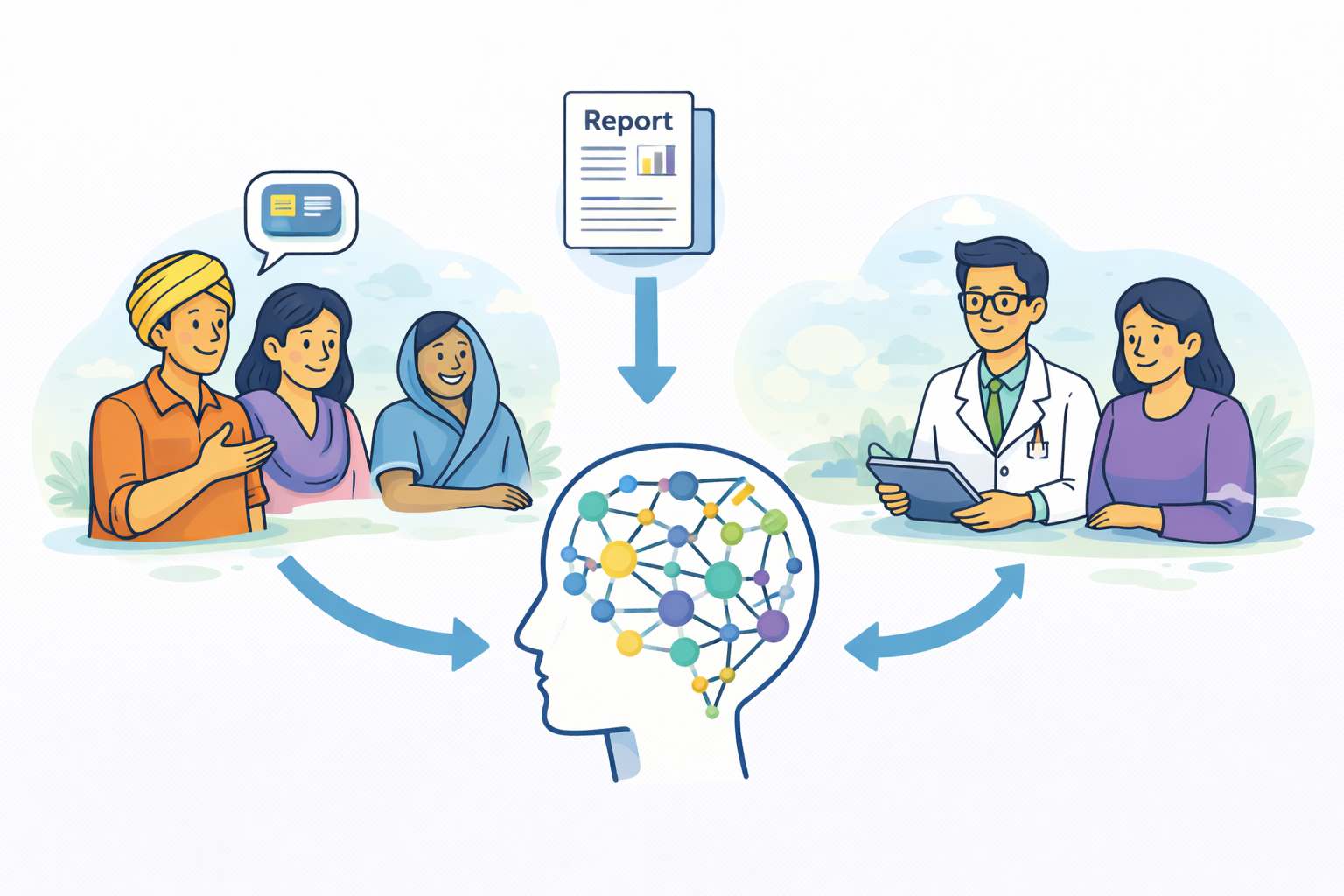
Apurva.ai is not a single application. It is a sense-making infrastructure. At its core, it helps organisations collect, connect, and interpret large volumes of information coming from different sources—especially human conversations and lived experiences. The platform works by bringing together three types of inputs.
First, it captures community voices—what people on the ground are experiencing and observing.
Second, it integrates institutional knowledge—data, reports, research, and program insights from organisations.
Third, it connects these inputs to reveal patterns, relationships, and emerging insights. The output is not raw data. It is structured understanding.
In simple terms, Apurva.ai turns fragmented information into something that can guide decisions.
How the system works
The platform is built around a cycle described as listen, learn, act. Listening involves capturing inputs from communities and stakeholders. These are not just surveys or forms, but conversations, field insights, and contextual observations.
Learning involves combining these inputs with other sources of knowledge. The system uses advanced processing techniques to identify patterns, themes, and connections.
Acting involves using these insights to inform decisions—whether in program design, policy, or strategy. This cycle is continuous. Each round of action generates new inputs, which feed back into the system.
The result is a dynamic process rather than a one-time analysis.
What changes for organisations
Without systems like Apurva.ai, organisations often operate in silos. Field teams collect information, but it remains local. Reports are written, but they are static. Decisions are made based on partial visibility. With Apurva.ai, these elements become connected.
Insights from one region can inform another. Conversations that would normally disappear after meetings are captured and analysed. Patterns that are not visible at a local level become visible at a system level. This changes how decisions are made.
Instead of relying only on predefined metrics, organisations can respond to emerging signals from the ground.
Where it is being used
Apurva.ai is being applied across multiple domains, including healthcare, agriculture, livelihoods, education, and policy. In healthcare, it helps connect insights from practitioners, field workers, and communities, improving how programs are designed and adapted.
In agriculture, it enables sharing of farmer innovations across regions, allowing practices developed in one context to be adapted elsewhere.
In policy and governance, it helps incorporate ground-level feedback into decision-making processes. Across these use cases, the underlying function remains the same: connecting distributed knowledge.
Product and technology layer
Apurva.ai uses a combination of technologies to process and connect information. These include systems that can read and interpret text, process audio and conversations, and generate structured insights from unstructured inputs. It also supports multiple languages and modes of interaction, including voice and messaging platforms, making it usable in diverse environments.
One of its internal tools focuses on capturing conversations and turning them into structured insights that can be reused across teams. The emphasis is not on replacing human judgment, but on augmenting it by making more information visible and usable.
Funding and organisational structure
Apurva.ai operates as a not-for-profit initiative under the Centre for Exponential Change, structured as a Section 8 entity in India. Its support comes from philanthropy, institutional partnerships, and ecosystem collaborators rather than traditional venture capital. It has been backed and mentored by organisations and individuals within the Indian philanthropy and development ecosystem, including initiatives linked to Rohini Nilekani.
This structure reflects its role as shared infrastructure rather than a commercial product.
What makes the approach different
Apurva.ai stands apart because of where it sits in the system.
Most tools in this space focus on data collection or analytics.
Apurva.ai focuses on sense-making—the process of turning diverse inputs into shared understanding. It also emphasises collective intelligence. Instead of treating knowledge as something owned by a single organisation, it treats it as something that emerges from networks.
Another difference is its design for complex systems. Instead of simplifying problems into linear models, it works with interconnected, evolving realities.
Finally, it is built as open infrastructure, allowing different organisations to use and adapt it.
Market response and challenges
The model has gained traction among organisations working on complex, multi-stakeholder problems. Its value is most visible in environments where traditional data systems fall short—where context matters as much as numbers.
However, there are challenges. Capturing meaningful inputs requires trust and participation from communities and organisations. Processing diverse, unstructured data at scale is technically complex. Adoption also depends on how well the system integrates into existing workflows. Despite this, the ecosystem approach allows it to evolve continuously as more participants engage with it.
The global context
Apurva.ai operates within a broader shift toward systems thinking and network-based approaches to problem-solving.
Globally, there is increasing recognition that complex challenges—such as climate change, public health, and livelihoods—cannot be addressed through isolated interventions.
Digital platforms are emerging to support collaboration, knowledge sharing, and data-driven decision-making. Most of these platforms, however, are either data-centric or enterprise-focused.
Apurva.ai’s positioning is different. It focuses on combining human insight with technological processing, and on making this accessible across diverse contexts.