For most digital systems, language is still treated as an afterthought. Interfaces are designed in English first, and then translated into other languages, often inconsistently and without context.
This creates a usability gap, especially in a country like India where a large share of users are more comfortable in regional languages.
Devnagri AI was built to address this operational problem—how to make digital products work across Indian languages in a way that is accurate, scalable, and usable in real-world systems.
Origin
Founded in 2019, Devnagri AI emerged from the recognition that translation alone is not enough. Enterprises, governments, and platforms need systems that can handle multiple languages consistently across interfaces, documents, and workflows. The company’s early focus was on building tools that could automate this process without losing meaning or context.
The founding team, led by Himanshu Sharma and Niranjan Mahawar, brought together experience in product development and language technologies. Their starting point was practical: organisations were spending significant time and effort manually translating content into multiple Indian languages, often with uneven quality. The goal was to build a system that could reduce this effort while maintaining accuracy.
From the beginning, Devnagri AI positioned itself as an enterprise platform rather than a consumer app. Instead of building a standalone translation tool, it developed APIs and workflows that could plug into existing systems such as websites, apps, and internal tools.
Product
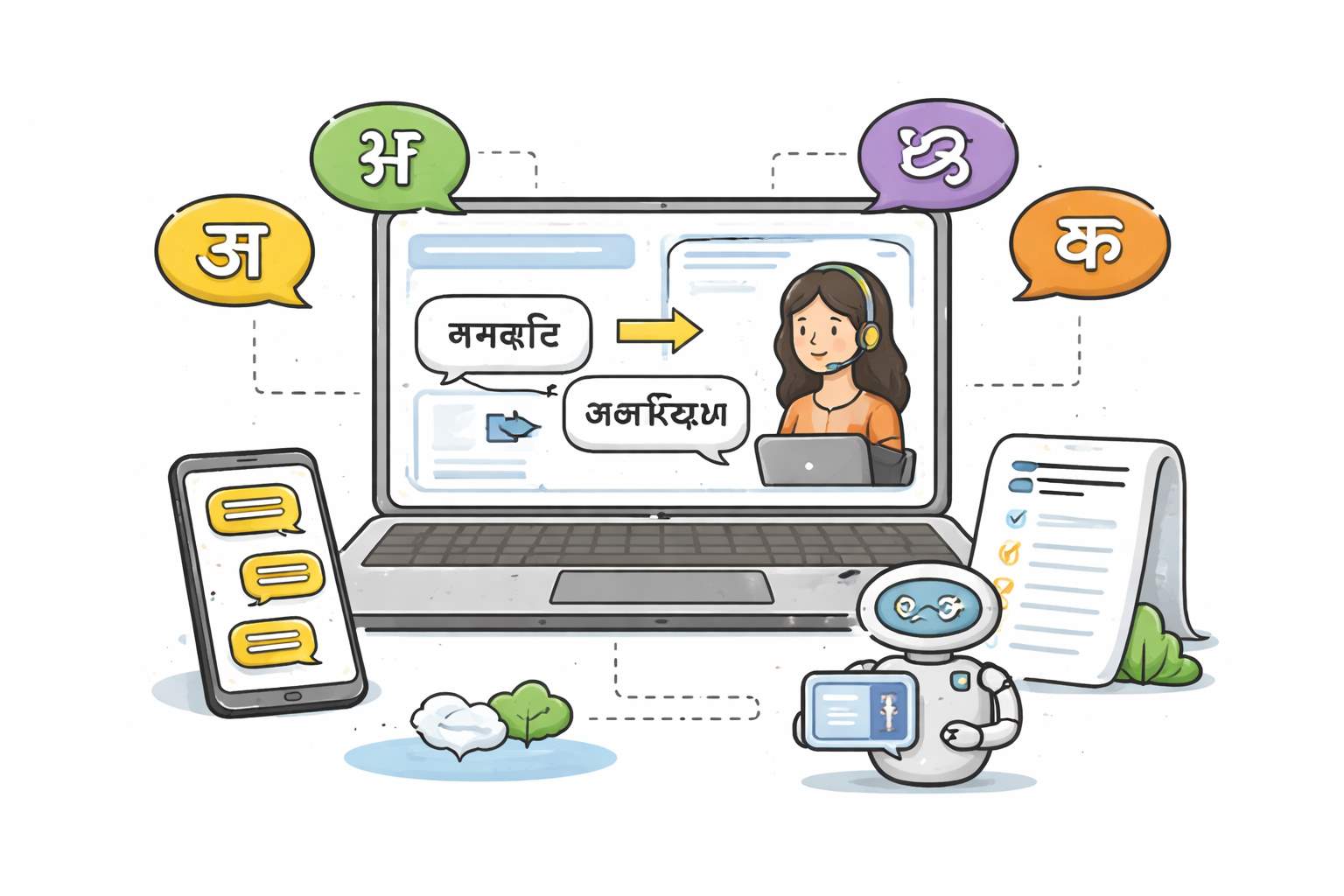
At the core of Devnagri’s offering is a language engine that combines machine translation with human validation. The system uses AI models to generate translations, but also allows for human review and correction where needed. Over time, these corrections are fed back into the system to improve accuracy for specific domains.
In practical terms, this means an organisation can upload content—such as a website, a document, or a user interface—and the system will generate translations across multiple languages. These translations can then be reviewed, edited, and approved within the same platform.
Challenges
One of the key challenges in Indian language processing is context. Words and phrases can have different meanings depending on usage, region, and domain. Devnagri addresses this by allowing organisations to build custom language models. For example, a banking application can train the system on financial terminology, while a healthcare platform can adapt it for medical content.
This domain-specific tuning is important because generic translation systems often produce outputs that are technically correct but not practically usable. By incorporating feedback loops and customisation, Devnagri aims to make translations more aligned with how language is actually used in specific contexts.
Another aspect of the platform is workflow management. Translation is rarely a one-step process. Content often goes through multiple stages—drafting, translation, review, approval, and publishing. Devnagri provides tools to manage this process, including role-based access, version control, and integration with content management systems.
The system is typically deployed as a cloud-based service. Enterprises integrate it into their digital infrastructure, allowing content to be translated automatically as it is created or updated. This is particularly useful for platforms that need to maintain consistency across multiple languages in real time.
Deployment
In terms of deployments, Devnagri AI has worked with government departments, financial institutions, and digital platforms. One of the key use cases has been public service delivery, where information needs to be accessible in multiple languages. This includes portals, forms, and informational content used by citizens.
Another area of deployment is in enterprises expanding into non-English-speaking markets within India. Companies can use Devnagri to localise their apps and websites, making them more accessible to regional users without building separate systems for each language.
Performance in these deployments is usually measured in terms of turnaround time and consistency. Organisations are able to translate large volumes of content much faster compared to manual processes. At the same time, the ability to maintain a centralised language system helps ensure that terminology and phrasing remain consistent across different parts of the platform.
Global context
Devnagri operates in a space that includes both global and local players. International platforms like Google Translate and Microsoft Translator provide broad language coverage and are widely used for general-purpose translation. However, they are not always tailored to specific domains or workflows.
There are also Indian startups focusing on similar problems. Reverie Language Technologies offers localisation and language infrastructure solutions for enterprises. Koo has built its own language stack to support multiple Indian languages within its platform.
What differentiates Devnagri is its focus on combining translation with workflow and domain adaptation. Instead of treating language as a standalone feature, it integrates it into how organisations manage content.
Globally, the category of language AI is expanding as digital services reach more diverse user bases. In many regions, English is not the primary language of users, which creates a need for localisation at scale. This is particularly relevant in countries with high linguistic diversity.
Advances in natural language processing have made it possible to automate translation with increasing accuracy. However, challenges remain around context, cultural nuance, and domain specificity. This is why many systems are moving toward hybrid models that combine AI with human input.
Another trend is the shift from translation as a one-time activity to continuous localisation. As content is updated frequently, systems need to handle changes in real time. This requires integration with content pipelines rather than standalone tools.
Devnagri AI is positioned within this shift. By focusing on APIs, workflows, and customisation, it aims to become part of the underlying infrastructure that supports multilingual digital systems.
The long-term relevance of this category is tied to how digital access evolves. As more users come online in regional languages, platforms will need to operate natively in those languages rather than treating them as secondary options.
For organisations, the question is not whether to support multiple languages, but how to do it efficiently and consistently. Systems like Devnagri provide a way to manage this complexity without relying entirely on manual processes.
The challenge going forward will be maintaining accuracy while scaling across languages, domains, and use cases. Language is inherently complex, and even small errors can affect usability and trust.
Devnagri’s approach—combining machine translation, human validation, and workflow integration—offers a practical way to address this. It does not eliminate the need for human input, but it reduces the effort required to manage multilingual systems at scale.
- Our correspondent