India burns millions of tonnes of agricultural residue every year.
Crop waste such as rice husk, paddy straw, sugarcane residue, and agro-industrial waste often have limited commercial use, and open burning remains common in several regions.
Pune-based Greenjoules is building a business around converting that waste into liquid fuels that can directly replace fossil diesel and naphtha without requiring engine modifications.
Founded in 2018, Greenjoules operates in the advanced biofuels category, specifically second-generation or 2G biofuels. Unlike first-generation biofuels, which are typically made from food crops such as corn, sugarcane, or vegetable oils, Greenjoules uses agricultural residues and renewable waste streams as feedstock. The company says this avoids the “food versus fuel” problem associated with some earlier biofuel models.
Greenjoules was founded by V. Radhika, V.S. Shridhar, S. Viraraghavan, and R. Sethunath. The founding team brings together experience across manufacturing, industrial operations, and energy systems.
Greenjoules positions itself as a deep-tech bio-refinery company rather than a fuel blending company. Its core technology uses thermochemical conversion processes to convert agricultural residue into crude-like intermediates, which are then refined into renewable diesel, renewable naphtha, and related products. The process technology has been developed internally and is not licensed from external technology providers.
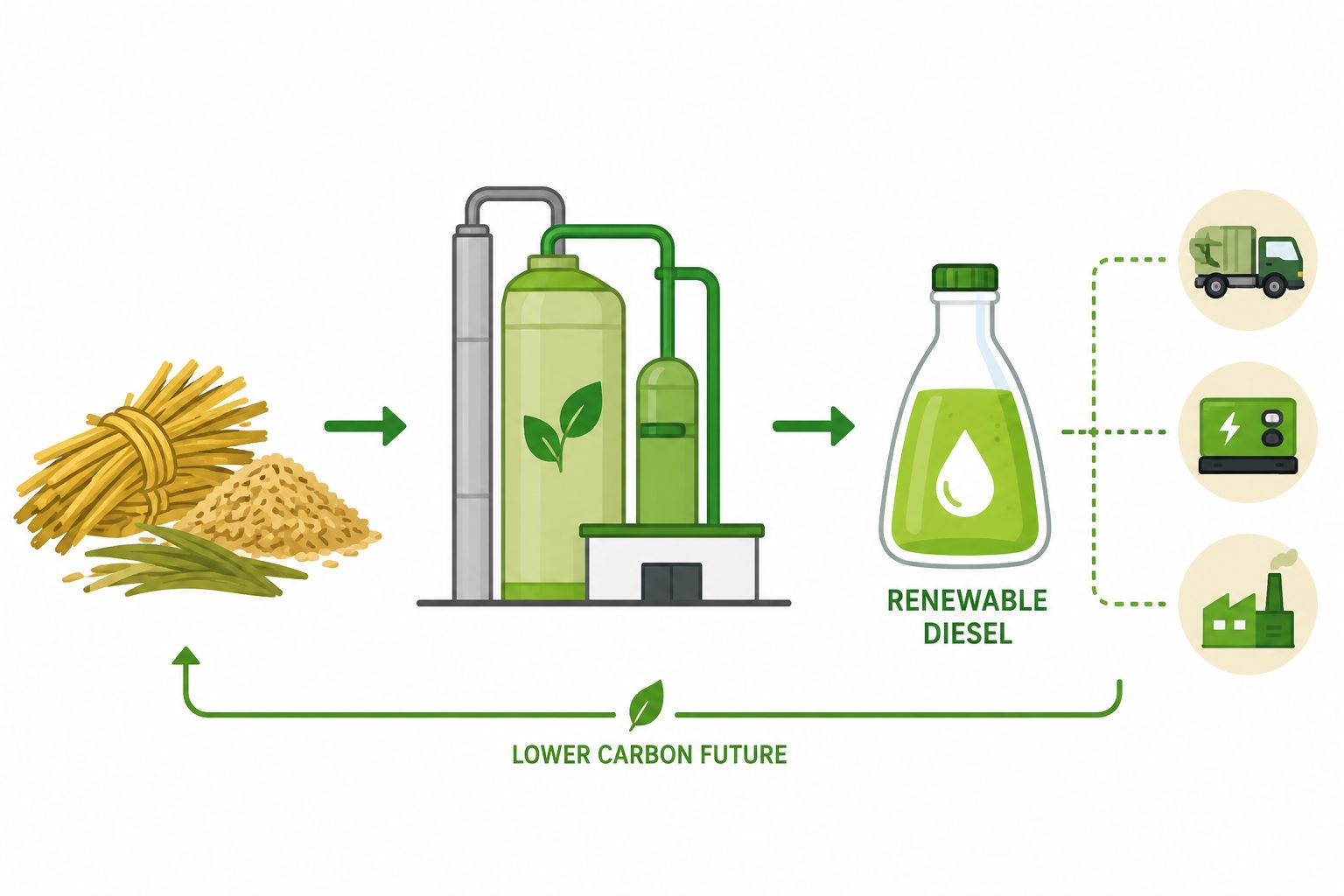
The company’s primary product is renewable diesel, also called Hydrotreated Vegetable Oil (HVO) or advanced 2G renewable diesel. Greenjoules says the fuel is chemically similar to conventional diesel and can be used directly in existing diesel engines, industrial boilers, generators, and transport fleets without requiring retrofitting or engine redesign.
This “drop-in fuel” approach is important because many alternative fuels require changes to engines, storage systems, or fuel distribution infrastructure.
Greenjoules is instead trying to create fuels that behave similarly to fossil fuels but carry a lower lifecycle carbon footprint. Its renewable diesel meets Indian diesel standards under BIS:1460 and IS19275. The company also claims sulphur levels below 10 mg/kg, which is lower than conventional diesel and aligned with ultra-low sulphur fuel standards.
The process begins with collection of agricultural residue and agro-industrial waste. Feedstocks mentioned by the company include rice husk, paddy straw, sugar industry waste, and other biomass residues. This material is processed through catalytic thermal cracking and refining systems that convert solid biomass into liquid hydrocarbons. The process also produces LPG-like gases and carbon-rich solids alongside renewable diesel and renewable naphtha.
Greenjoules says one advantage of its process is carbon reduction. According to the company website and government-linked publications, the lifecycle emissions of its fuel can be below 25 grams of CO2 equivalent per megajoule under certain conditions.
The company currently operates a biorefinery in Chakan near Pune.
In terms of funding, Greenjoules raised a $4.5 million Series A round in 2021 from Blue Ashva Capital through the Blue Ashva Sampada Fund.
Greenjoules states that the fuels could potentially cost less than conventional diesel under certain production conditions. The company also said that a 100 kilolitre biofuel plant could recover investment costs within roughly two to three years.
Greenjoules has stated that its fuels are suitable for industrial users, diesel-powered vehicles, generators, and boilers.
The broader advanced biofuel sector has attracted growing attention globally because it addresses sectors that are difficult to electrify fully, including heavy transport, industrial heat, aviation, shipping, and backup power systems. Governments in Europe, the United States, India, and Southeast Asia have all introduced biofuel blending targets and low-carbon fuel policies.
Globally, companies such as Neste in Finland and Diamond Green Diesel in the United States have become major producers of renewable diesel using waste oils and fats. Other firms are exploring biomass-to-liquid fuels using forestry waste, municipal waste, or agricultural residue. Sustainable aviation fuel (SAF) has also become a major area of investment globally.
In India, Greenjoules operates in a relatively small but growing ecosystem of waste-to-fuel startups and bioenergy companies. Some firms focus on compressed biogas, others on ethanol, while companies such as Sea6 Energy work on marine biomass-derived fuels. Greenjoules differentiates itself by focusing specifically on thermochemical conversion of agricultural residue into diesel-equivalent fuels.
One challenge for the category is economics at scale. Collecting agricultural residue consistently is logistically difficult because feedstock availability varies by region and season.
Advanced biofuel plants are also capital-intensive compared to conventional fuel blending operations. The industry’s long-term growth will likely depend on carbon pricing policies, blending mandates, industrial decarbonization targets, and the cost competitiveness of renewable fuels against fossil diesel.
For Greenjoules, the next phase will depend on whether it can move from pilot and early commercial operations into sustained industrial-scale fuel production. The company has built a position around waste-derived drop-in fuels at a time when governments and industries are looking for lower-carbon alternatives that can work within existing fuel infrastructure. But large-scale deployment data and long-term commercial validation are still developing across the global advanced biofuel sector.
- Our correspondent