There is a pattern in agriculture that is easy to miss. Farmers work hard to grow crops, but a large part of their losses does not happen in the field. It happens after harvest—when crops spoil, when storage fails, or when power supply is unreliable.
Ecozen begins at this point. It is not trying to increase how much farmers grow. It is trying to ensure that what they grow is not lost—and that the systems around farming actually work.
The origin:
Ecozen was founded in 2010 by Devendra Gupta, Prateek Singhal, and Vivek Pandey, all alumni of Indian Institute of Technology Kharagpur.
The company started with a simple observation: agriculture in India depends heavily on electricity and diesel. But power supply is unreliable, and diesel is expensive. Farmers either overpay or underperform.
The founders did not begin with a broad climate vision. They began with a practical problem—how to make farm operations work without depending on unstable energy systems. That led them to solar.
What Ecozen actually built
Ecozen builds solar-powered systems for agriculture and rural infrastructure. But the company is not just installing solar panels. It builds integrated systems that combine solar energy, electronics, and software.
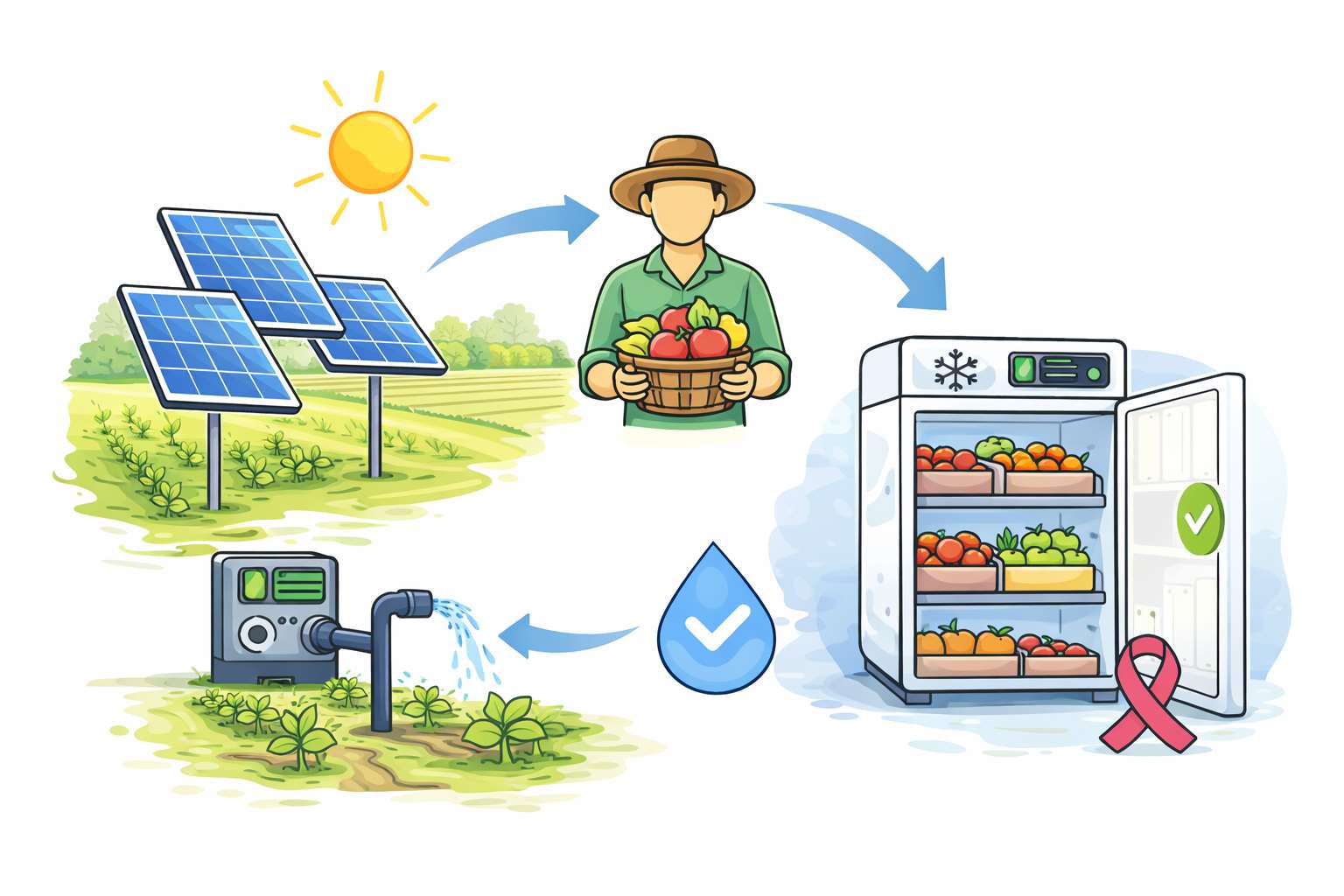
Its first major product was Ecotron, a solar pump controller. To understand this, think of irrigation. Farmers use pumps to draw water from the ground. These pumps usually run on grid electricity or diesel. When power is unavailable, irrigation stops. Ecotron replaces this dependency. It connects solar panels to irrigation pumps and uses intelligent motor control systems to optimise performance.
The system adjusts power usage based on sunlight availability and ensures that pumps run efficiently without damaging equipment. This means:
farmers can irrigate even without grid power, they reduce diesel costs and they get more predictable water access
The second layer: fixing post-harvest losses
After irrigation, Ecozen moved to a bigger problem: what happens after harvest.
Farmers often lose a significant portion of produce because of lack of cold storage. Traditional cold storage systems require continuous electricity, which is not always available in rural areas. Ecozen built Ecofrost, a solar-powered cold storage system. This system uses solar energy during the day and stores cooling capacity for use when sunlight is not available.
In simple terms: it keeps produce fresh without needing constant grid power
Farmers can store fruits and vegetables for longer periods, giving them flexibility on when to sell. This directly affects income.
How the system works
Ecozen’s products are built around three core technology layers. The first is solar energy—panels that generate power. The second is control systems—electronics that manage how power is used, stored, and distributed. The third is IoT and data—software that monitors performance and optimises usage. This combination allows the system to adapt to real-world conditions like fluctuating sunlight, changing load, and usage patterns.
Scale and adoption
Ecozen has scaled significantly over the past decade. It has deployed hundreds of cold storage units and tens of thousands of solar pump controllers across India and other markets. In some estimates, over 300,000 Ecotron units have been manufactured and deployed. The company’s solutions have impacted over a million farmers, improving irrigation efficiency and reducing post-harvest losses. This scale matters because agriculture is a distributed system. Impact only counts if it reaches large numbers of small users.
Funding and growth
Ecozen has raised over $100 million in total funding across equity and debt rounds. Its investors include global impact funds like responsAbility Investments, Omnivore, and Nuveen. Recent funding has leaned heavily toward debt, reflecting the company’s hardware-heavy model and growing revenue base.
What makes the approach unique
Ecozen’s differentiation lies in how it combines energy, agriculture, and infrastructure. First, it builds systems, not components. Instead of just selling solar panels, it creates complete solutions tailored to farm use cases.
Second, it focuses on reliability rather than just sustainability. Farmers adopt the product because it works consistently—not just because it is clean energy.
Third, it targets critical points in the value chain—irrigation and storage—where small improvements create large economic impact.
Fourth, it uses intelligent control systems to make solar energy usable in real-world conditions.
Finally, it operates in low-infrastructure environments, where traditional systems fail.
At a broader level, the company claims to have enabled over 1 billion units of clean energy generation and improved income for over 100,000 farmers. These outcomes are practical, not theoretical. They affect daily operations and income.
Market feedback and challenges
The strongest adoption has been in regions with unreliable electricity and high dependence on diesel. Farmers value the cost savings and reliability. For many, the shift from diesel to solar is not just environmental—it is economic.
However, there are challenges. Upfront costs can still be high, even if long-term savings are clear. Financing becomes critical. There is also the challenge of maintenance and service in rural areas, where infrastructure is limited.
The global context
Ecozen operates in the broader space of climate-smart agriculture and clean energy infrastructure. Globally, there is growing interest in solar-powered irrigation, cold chains, and decentralised energy systems. However, many solutions are fragmented—focused on either energy or agriculture.
Ecozen’s approach integrates both. This makes it particularly relevant for emerging markets in Asia and Africa, where similar conditions exist: smallholder farming, unreliable power, and post-harvest losses.
-Our correspondent